
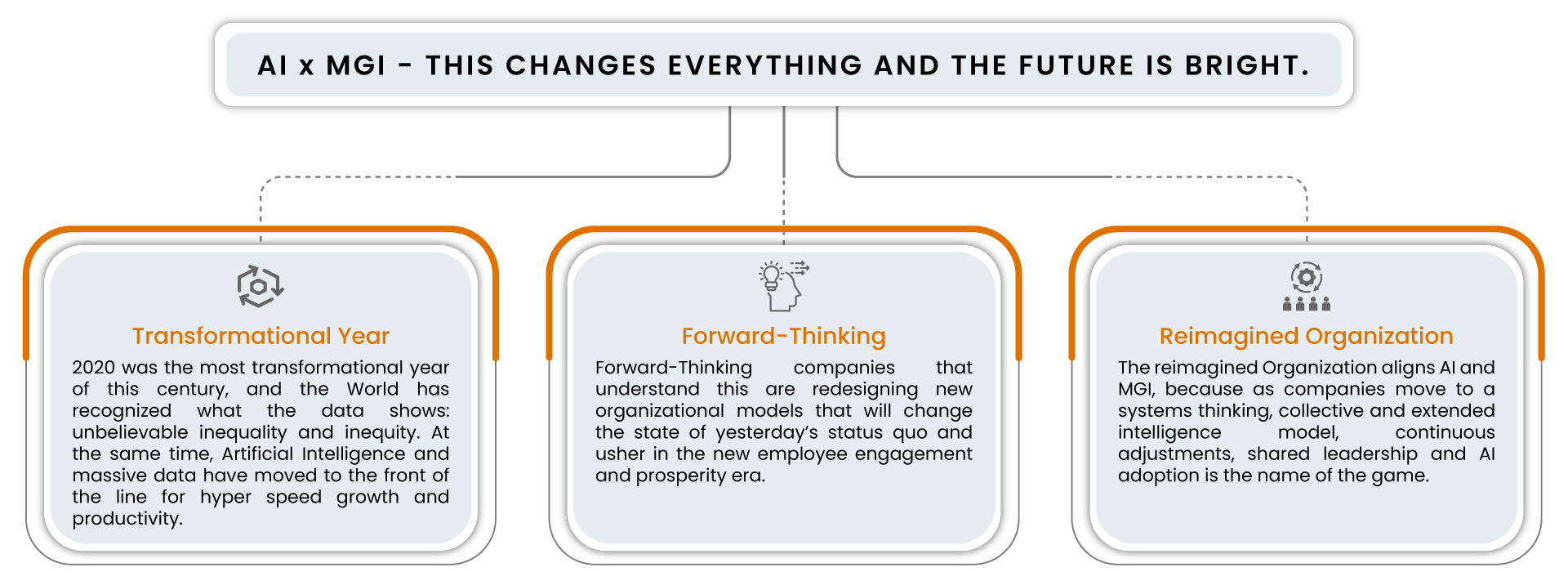
The relation between AI and forward-thinking leadership is one of interdependency and reciprocal support. The successful use of AI requires leaders who can devise a strategy with clearly defined tactical steps to successfully bring organizations to the next stage, moving away from bureaucratic models to more nimble and agile forms of collaboration.
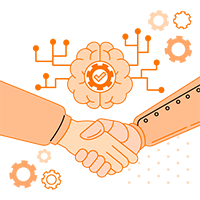
This is really important because when you talk about human-robot or human-AI teamwork this is where things like trust and credibility
When we look at these trends over time, the challenge we face is that the demand of people requiring these kind of personalized
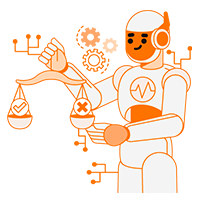
It essentially unlocks our human potential. The more you can holistically support a person not just cognitively, but socially and emotionally
Nimble organizations leverage the power of the many, where leadership skills are developed at every level of the organization. Contrary to some dystopian picture of the future, humans are expected to remain very much at the center of the action. To understand the impact of digital transformation, envision new business models, and architect an agile organization, leaders need to balance four capabilities:
enables leaders to explore the wider system, create a map of that system.
involves creating compelling images of the future.
involves inquiring, advocating, and connecting with others in and outside the organization.
involves developing new ways of achieving the vision.
To effectively lead in this environment, leaders need to think about creating a system of innovation. What this means is creating an organization that consistently creates new products, new processes, new ways of organizing, and new business models. What leaders will have to do to get to this innovation engine, as it were, is to consider giving people more autonomy; so they can invent, so they can innovate. Reach out to the larger ecosystem.
You will need to be the designer of X-Teams. X-Teams is a particular form of team that’s very flexible and nimble. It enables the members of the team to reach out, to do the sense-making that they need to do, to understand environmental change, to align up the organization with the strategy makers.
This is paramount. coordinate across the full scope of the project in order to make sure that all of the people who are working on it are working in a coordinated fashion.
The concept of incomplete leader is to show that no leader is perfect. No leader can carry out all the capabilities and do them exceedingly well. Each leader has his or her own, what we call, leadership signature, his or her own unique way of leading.
Each person’s signature builds on that person’s strengths, weaknesses, successes, failures, values, and experiences. As such, we are very good at certain things and not so good at other things. Most leaders have signatures that rely on one, two, or, maybe at the most, three attributes to describe themselves.
Once you understand that, it’s easier to say, OK, does this leadership signature map on to the requirements of today’s environment of the tasks that we need to do? And if not, how do I need to shift and develop my own leadership signature to effectively move ahead
Systems Thinking – In order to make sense of a constantly changing environment and reduce errors in individual and collective decision-making, leaders must become systems thinkers, analyzing events by contemplating their interconnections.
Learning Dilemma – Companies that have continued to grow legacy vertical structures struggle to overcome challenges and sometimes can’t see the problems ahead. What happens when actions have consequences beyond the individual learning horizon? What happens when individuals cannot observe the consequences of actions that are beyond the breadth of their vision in time and space? To overcome this difficulty, organizations have been creating new nimble hierarchies, and breaking themselves down into smaller components.
Vicarious Learning – is this process by which teams—and individuals for that matter—learn to do better based on the prior related experiences of others. And better can mean better in terms of small improvements, or it can be massive innovative moves and everything in between. In very fast-moving Nimble companies, what teams do and individual leaders do who learn successfully and vicariously – is that they find models in fields and contexts that are somewhat different from the one in which they work, and they take inspiration from that. They pick up concepts and principles from that, and then they come up with solutions that is different – and innovate.
Prediction Markets – are markets that involve making forecasts about states of the future, using predictive analytics. They are a powerful means of harnessing collective intelligence to predict future events. Prediction markets can help a company respond to and anticipate change, representing a creative alternative to traditional management practices. Instead of following cookie cutter orders for all decisions, individuals and teams can use their collective intelligence to make their own well-informed decisions, appropriate to local circumstances.
Collective & Extended intelligence – Nimble organizations support individuals and groups in their efforts to use data, transform it into information to generate new knowledge that will help them make sense of the environment, and build a shared vision, inventing and connecting across boundaries. Leaders of agile organizations believe in the power of Collective Intelligence (CI) and using MGI to further advance CI is part of our proprietary system. Now that we move toward using more AI, the machine cognition inherent in AI can replace and replicate some human tasks quickly, effectively, and at great scale and therefore AI may be viewed as a cognitive extender, that is, extend and enhance human capabilities and intelligence by providing data and insights for fast and continuous decision making.
The next generation of leaders and employees are focused on self-awareness and development. They want to grow and try new things. Gone are the days of staying in one job function without personal stretch development and staying locked up for life in one career. This has stifled individual growth and happiness while stagnating corporate innovation and progress.
Nimble organizational leaders who know their strengths and their weaknesses, and everyone has them. Not acknowledging humanism is a failure. Next gen leaders are developing their leadership signature and when you know what your own signature looks like, it means that you can go and fill your teams with people who complement your skills. If you are great at sensemaking envisioning, find some other people to join your team who are very good at inventing and relating.
The key is that together you can have great leadership. Alone, you have a great signature, but it isn’t enough. So it’s important to understand we are all incomplete leader, but that together we can be a complete high performance team.
Sensemaking, a term coined by organizational psychologist Karl Weick, means exactly what it says: making sense of the world around you. It involves translating a soup of data, information, changing trends, and experiences into a map or model of what is going on. What are the relevant issues and trends that relate to your situation? Who has encountered a situation or problem like this before, and what can you learn from it as you formulate your own plans?
Sensemaking sounds simple, but it is mentally challenging and often lonely work that requires courage to stretch yourself and others out of familiar ways of thinking and acting in order to meet the world anew. Because sensemaking is so critical for leadership, but is not well-understood or emphasized, we will spend a little extra time on it here.
Relating, like sensemaking, is a leadership capability that until recently did not receive as much attention as the more traditional concept of leaders as visionaries and inventors. But today’s flatter, networked organizations press leaders to build trust, influence other people, and engage in two-way dialogue rather than giving orders and demanding compliance.
Relational leaders do this through a balance of inquiry—listening with a genuine intent to understand—and advocacy—stating opinions and explaining the reasoning behind them without aggression or defensiveness (Ancona et al., 2007; Argyris & Schön, 1995). This process is not free from conflict; healthy debate is necessary for good decision-making. Relational leaders blend inquiry and advocacy to keep dialogues respectful and focused toward a common goal, while also welcoming tough questions and divergent opinions.
Visioning involves generating an inspiring picture of a future state, one that gives people a sense of meaning about what they are doing. Visioning is, in essence, about telling a good story that opens people’s hearts and minds to new possibilities.
Elon Musk is perhaps one of the best modern-day business storytellers and visionaries. The mission of his company, Tesla Motors, is to “accelerate the world’s transition to sustainable transport.” The company revolutionized the electric car industry and rebranded its stodgy image with the first Tesla product: an ultra-fast sports car with a sleek design and a 200+ mile-per-hour range, which was unheard-of at the time.
Inventing is like the familiar business concept of execution, but with an added splash of creativity to develop new structures and cultures for organizing work and producing outputs. The early Ford assembly line and the famed Toyota Production System (TPS) both executed the manufacturing of cars, but Toyota’s approach was a radical departure from Ford’s assembly line method.
The TPS integrated new physical systems for controlling quality and production speed, such as “kanban” signs; new cultures of democratic teamwork and psychological safety (Edmondson, 1999; Nembhard & Edmondson, 2011); and new processes such as training workers in kaizen—or continuous improvement methods. The result: substantially higher quality and lower rates of problems experienced by Toyota customers, according to J. D. Power and Associates studies done at the time.
Welcome to the journey! The new era of generationally-centric, AI-technology adoption and enthusiasm will unlock collaborative teams capable of delivering ideation, innovation, progress and productivity that finally rewrites the Pareto Principle!
When you integrate Developmental AI Learning, with Next Gen Leadership styles designed for the 21st Century, you get Employee Experience Supercharged.
The application of this system, across Talent Acquisition, Talent Development and Management to Talent Retention, for Internal Mobility and Succession Planning is fundamentally financial and ROI. Our goal is to align across the Board/CEO/CHRO/CFO agendas holistically.


All rights reserved | © 2026