

The world is witnessing an unsettling trend in the workforce, one where discontent and disconnect are on the rise. Well, it’s not just about the paycheck or the corner office anymore. It’s about searching for meaning in the 9-to-5, for personal growth and professional success. It’s what I call a growing epidemic: the rise of the unhappy employee. The issue here is deeper, hitting the very core of what motivates us as individuals. Let’s dive into what it truly means for businesses and their teams.
A silent majority of people today feel like their job is just something they do, rather than an extension of who they are.
Having spent over 26 years in human resources, I’ve been on the front lines, watching the tides change. And, I want to share with you not just the “what” but the “why” and the “how” we can turn the tide on this wave of workplace dissatisfaction.
In this series, we’ll explore the landscape of employee unhappiness, tackling it from both a micro and macro perspective. From personal fulfillment gaps to systemic issues within organizational culture, we’ll examine why the modern employee’s well-being has taken a backseat, how they became unhappy employees, and what this means for the future of work.
At the heart of this shift lies a complex web of four critical gaps that are contributing to the rise of the unhappy employee.
Today, employees are looking for more than just a job. Personal gaps arise when there is a lack of alignment between an individual’s purpose and their work. If you’re the kind who’s excited upon waking up, congratulations, you’re definitely in a happy space. On the other hand, if you hit snooze and dread going to the office, just like kids dread going to school, there’s a serious issue.
Ask yourself-
Humans are inherently social beings, and the workplace is a crucial social system. Belongingness gaps appear when employees feel out of place or misunderstood within their workplace. This can be due to many factors—from cultural misalignments to a lack of clarity in roles. When employees don’t feel like they belong, engagement plummets, and with it, productivity and loyalty to the company.
Ask yourself:
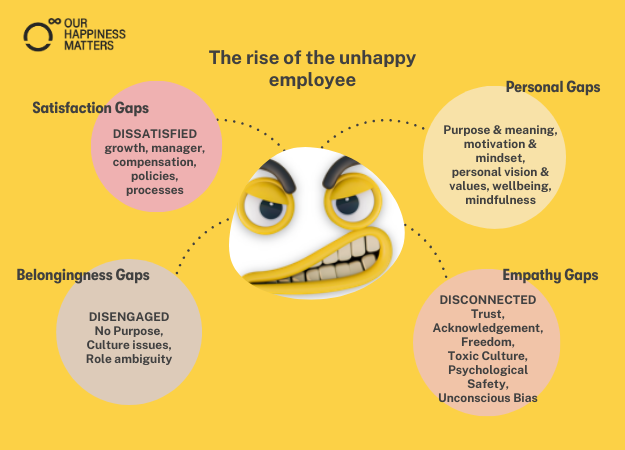
Next, we have the satisfaction gaps, which include the more tangible aspects of employment. When employees feel stunted, not only in their growth prospects but also in their relationships with managers, and their overall compensation; when the policies and processes within a company become sources of frustration, the outcome is invariably a workforce that feels undervalued and unfulfilled.
Elements like growth, policies, processes, and relationships with peers and managers are fundamental to an employee’s day-to-day experience and can either empower them to achieve their best or restrict their potential. When these needs are not met, it leads to employees constantly looking outwards for opportunities that better meet their expectations.
Ask yourself:
Lastly, empathy gaps represent the emotional intelligence of an organization. These gaps might be the most telling of all. This includes trust, acknowledgment of efforts, the freedom to express ideas, and the existence (or lack thereof) of a supportive and inclusive culture. Toxic environments, a lack of psychological safety, and unconscious bias only exacerbate this gap.
Employees today are not just asking for better experiences; they are demanding environments where they can thrive without fear of being marginalized or mistreated.
Ask yourself:
Now that we know the four critical gaps contributing to the rise of unhappy employees, the obvious next question is—what’s the solution?
If you see the rise of the unhappy employee as a challenge; an unsurmountable challenge it will be. But what if we looked at it as an opportunity to reevaluate and reinvent our approach to our most important asset—our workforce?
Well, businesses need to wear a new lens—one that sees employees as whole beings with emotional needs, aspirations, and personal lives.
For employees, it’s about taking charge of their individual well-being and crafting a mindset and habits that foster resilience and positivity.
This is not a one-and-done fix. It’s a journey toward a more human-centric workplace where the sweet spot of success is at the intersection of organizational transformation and personal evolution.
The next blog in this series will dive into how we reached this stage of unmet expectations in the first place. We’ll trace the evolution of the workforce against the backdrop of Maslow’s hierarchy of needs, the profound impact of COVID-19, the Great Resignation, and the shift towards hybrid work and the gig economy. We’ll examine the current state of economic instability and understand how a multigenerational workforce navigates these turbulent times.
Stay with me as we explore these dimensions—because understanding the root cause is the first step in crafting effective solutions. Let’s together create workplaces where every employee can say, “I’m happy to be here.”
Author – Sriram Sadras
The Intrinsicana human performance system provides a dynamic and practical solution designed to evolve with you, seamlessly adapting to your unique organizational challenges.